
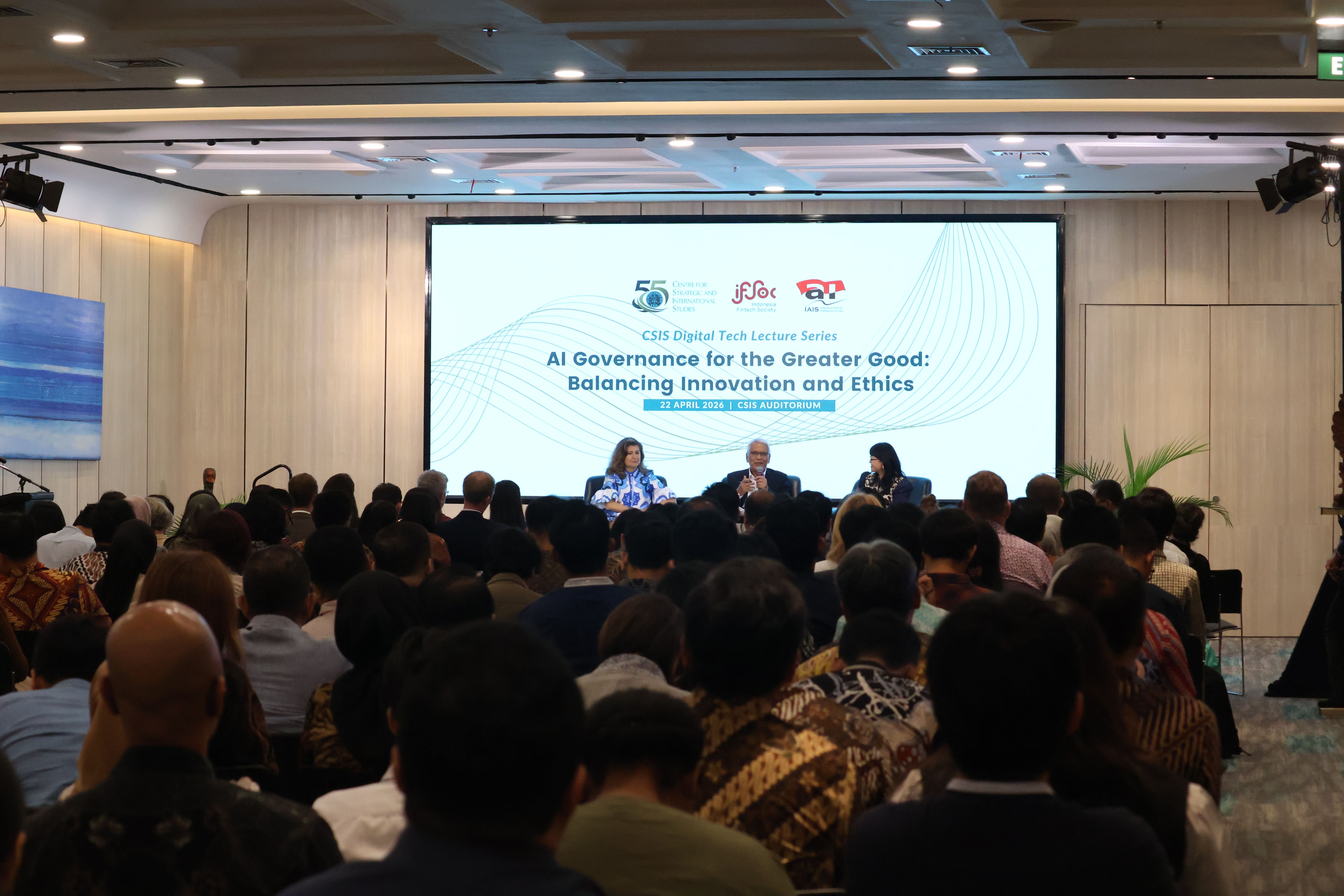
Jakarta, 22 April, 2026 – The Center for Strategic and International Studies (CSIS) Indonesia hosted a Digital Tech Lecture titled “AI Governance for the Greater Good: Balancing Innovation and Ethics”, attended by diverse participants, including experts and stakeholders. The event brought together the experts to discuss the development and governance of Artificial Intelligence (AI).
Welcoming Remarks
In his remarks, Yose Rizal Damuri, Executive Director, CSIS, highlighted the rapid global adoption of generative AI, which has reached 53% in three years, according to the Stanford AI Index 2026, faster than the adoption of computers and the internet. AI has a significant impact on increasing productivity across sectors. However, he also emphasized the risks of AI misuse, including deepfakes and information manipulation, which are increasingly visible in the Indonesian context, particularly during political campaign periods.
He further emphasized the importance of strengthening AI governance, focusing not only on risk mitigation but also on creating an ecosystem that supports innovation. Investment in digital infrastructure, competency development, and technological literacy are key for developing countries to maximize the benefits of AI. The discussion, which also featured Gabriela Ramos from UNESCO and Stella Christie, was supported by IFSOC and IAIS, as part of CSIS's efforts to promote the strengthening of AI governance towards the vision of a Golden Indonesia.
Digital Tech Lecture
Gabriela Ramos, Former Assistant Director-General for Social and Human Sciences, UNESCO, emphasized that the development of AI presents both enormous potential and global challenges that require shared governance. The technological evolution from machine learning to generative and agentic AI represents a significant leap in capabilities that mimic human cognition. However, the much faster adoption rate compared to previous technologies raises concerns because innovations are often launched without adequate safety testing. Furthermore, global competition concentrated in a handful of countries and companies reinforces the power imbalance in AI development. Therefore, global discussions and shared rules are crucial in determining the direction of this technology's development.
Despite its risks, AI holds enormous potential to provide benefits to humanity, from medical diagnosis and personalized education to solutions for climate change and agriculture. The AI cost has dropped by around 280x in 18 months (from $20 to $0.07 per million tokens), and, alongside public investment and open-source advances, this is opening up opportunities for more countries to widely adopt this technology. However, threats such as misuse, mass surveillance, job disruption, and increasing social inequality remain serious concerns. Ramos also highlighted that developing countries risk becoming mere consumers and providers of data if they do not build domestic capacity. Job market transformation is inevitable; by 2030, 170M jobs will be created, 92M jobs will be displaced, and 78M net new jobs will appear. Moreover, 90% of AI models come from commercial labs (up from 60% in 2023); fewer than 10 labs produce 80%+ of frontier models, which is risky for developing countries that are just consumers, leading to the loss of indigenous languages and features.
Furthermore, Ramos highlighted the "governance gap" in AI governance, where regulations lag behind the pace of technological innovation. She emphasized the importance of making human rights a key foundation for AI governance, as well as encouraging international cooperation and strengthening institutional capacity. Through the UNESCO framework, ethical principles such as accountability, fairness, and transparency must be implemented concretely, including in sanction mechanisms. Aligned with this approach, Indonesia’s National Strategy for AI Framework, supported through UNESCO’s RAM, has set 5 priority sectors: health services, bureaucratic reform, education & research, food security, and mobility and smart cities. She also proposed a "3I" approach—Institutions, Incentives, and Investments—to ensure inclusive and sustainable AI development. Ultimately, the future of AI is not predetermined, but rather the result of the choices and policies people make today.
Panel Discussion
Gabriela Ramos, Former Assistant Director-General for Social and Human Sciences, UNESCO, emphasized that AI-driven markets tend to concentrate power due to first-mover advantages, where early innovators accumulate data, talent, and infrastructure, making competition difficult. A key solution is separating data as a shared utility from service providers to enable broader access, and more AI service providers will emerge. At the worker level, the company is giving its employees AI as a tool to help them produce a greater output instead of training and enhancing skills, which leads to career stagnation. However, the key issue is not the technology itself. It’s about the organizational framework, understanding how it works, and how the technology can help us improve. Nevertheless, governance remains slow; although international frameworks exist, stronger institutions and more effective policy coordination are needed. Industry decisions also matter: Anthropic's choice not to release its powerful Mythos system after identifying potential misuse highlights the growing role of corporate responsibility alongside public governance.
Stella Christie, Vice Minister of Higher Education, Science, and Technology in Indonesia, emphasized that AI poses risks, including unemployment, internet security, reduced information reliability, and rising inequality. She also highlighted that other countries, including Indonesia, may find it difficult to catch up with LLMs developed by the US and China. Indonesia has a large amount of data, but awareness of data protection remains low. At the same time, the human brain learns through the process of creating, whereas AI generates content while skipping that process. Therefore, it's essential to develop the capability to evaluate AI using human critical thinking. Stella argued that Indonesia holds a strategic position in AI development given its data volume and market size.
Djisman S. Simandjuntak, Chair, Board of Directors, CSIS Indonesia Foundation, outlined that the key of AI development is institutional preparedness at the global, regional, national, and local levels. AI can be used for advancing life or for destructive purposes. Therefore, an ethical judgment becomes a challenge. Even though it's sophisticated, our human learning remains a better choice than machine learning. Human learning will continue to outcompete machine learning due to its richness.
Explore the full discussion on YouTube CSIS Indonesia through this link https://csis.or.id/L/DigitalTechLecture


